Software lifecycle notes — GOALS, waterfall, and verification vs validation
These pages are from a software engineering textbook I used in coursework. I grouped the figures here as a single reference: goal-oriented planning, how the waterfall model sequences activities (with verification and validation paired to each phase), an incremental variant, the textbook’s list of life-cycle subgoals, a reminder that method advice depends on context, and a short ethics passage about impact on people.
GOALS approach (Figure 3-1)
The GOALS flowchart is a top-down pattern: set overall life-cycle goals (functions, constraints, schedule, usability, maintainability), analyze the problem and sketch solution structure, separate concerns into subgoals, develop solutions for each subgoal in parallel where possible, then validate those solutions against the other goals and iterate until the decision “all goals satisfied?” is yes.
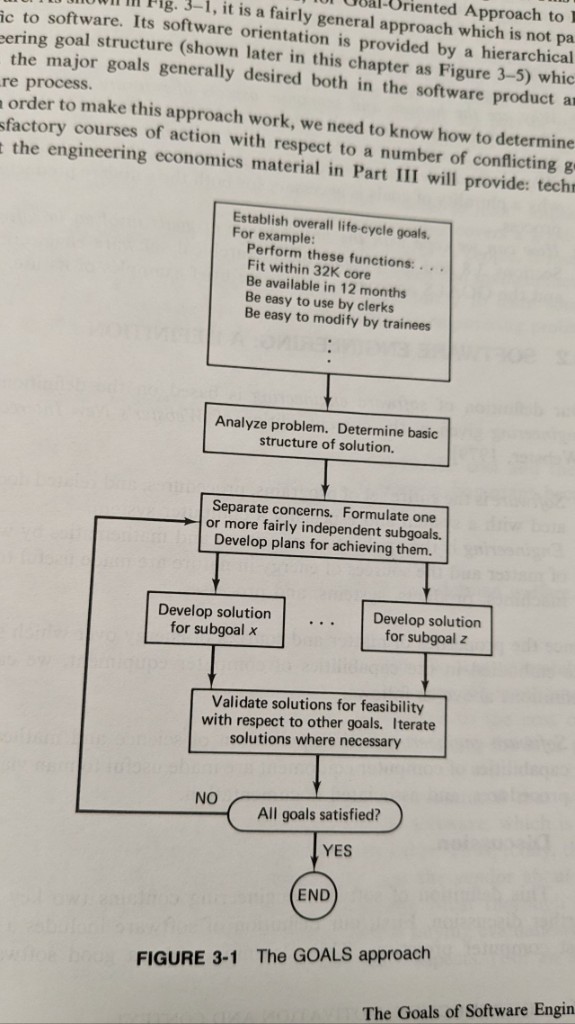
It reads like an early articulation of what later methodologies still do: decompose, check consistency across concerns, loop rather than assume a single pass is enough.
Sorting out software advice (Figure 3-4)
The “sorting out software advice” figure is a scatter of practices — top-down vs outside-in, walkthroughs, independent test teams, chief programmer teams, measurable milestones, configuration management, structured programming, “build it twice,” involve the user, and many more. The surrounding text stresses that the same slogan can be right in one situation and wasteful in another (for example, building a throwaway first version when the domain is unfamiliar vs when it is already well understood).
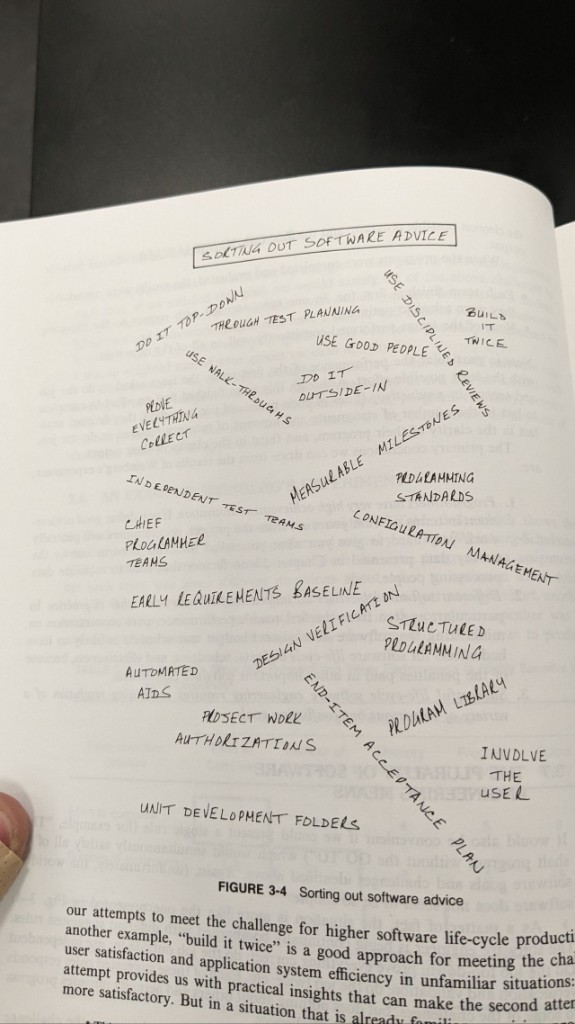
Useful as a checklist of ideas to consider, not as a single recipe to apply everywhere.
Ethics: urban school attendance system (Chapter 2 case study)
The italic quote on this page is the line I underlined in the margin: individual engineers can improve outcomes for society by paying attention to long-range human and social implications of designs, not only to technical correctness.
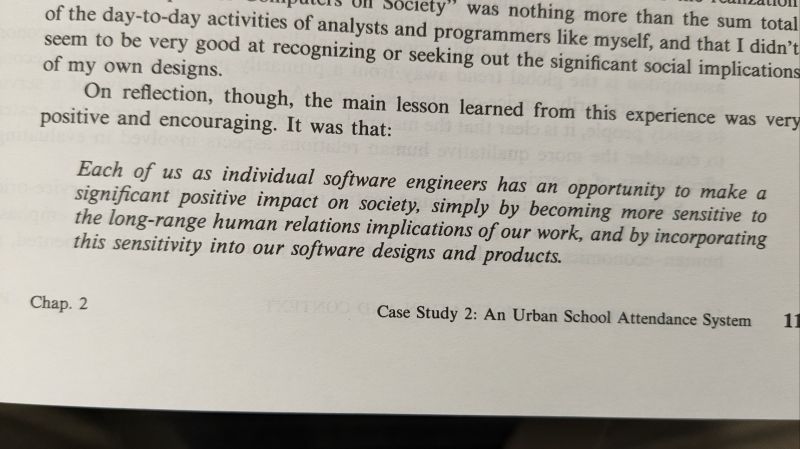
It pairs naturally with requirements and validation — “the right product” includes who it serves and how it affects them.
Waterfall life-cycle (Figure 4-1)
The classic waterfall diagram shows phases cascading in order. Each box is split diagonally: development work in one triangle and the matching V&V activity in the other — from system feasibility through requirements, product design, detailed design, code, integration, implementation, to operations and maintenance. Backward arrows express rework when a phase’s review finds problems.
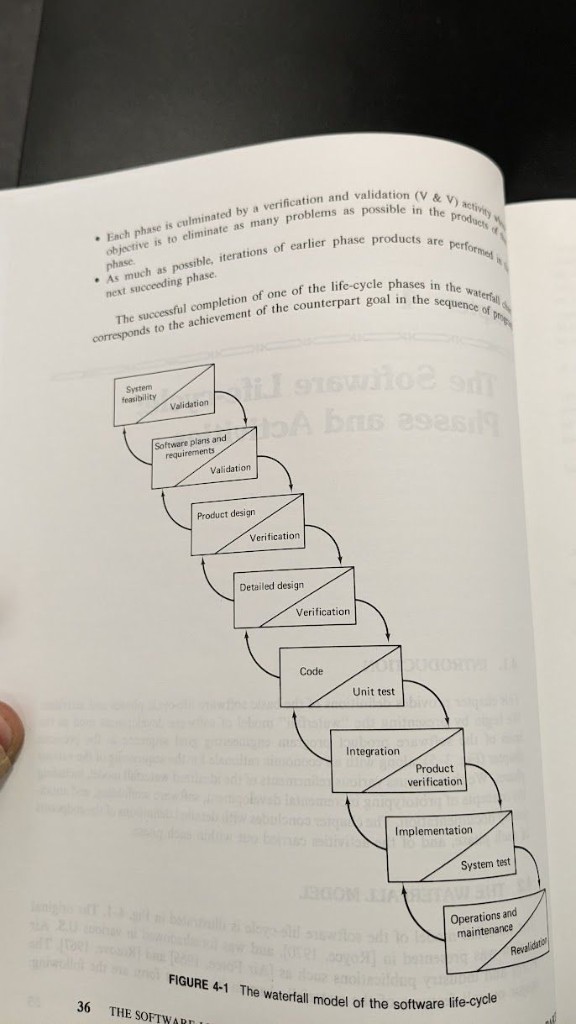
Even when a team does not ship “pure waterfall,” the diagram still names the kinds of artifacts and checks that keep showing up under other names.
Incremental waterfall (Figure 4-4)
The incremental variant anchors a shared product design, then runs parallel or staggered increments through detailed design, coding, integration, and the rest — each increment still carrying the same build / verify pairing and feedback to earlier steps (including back toward product design).
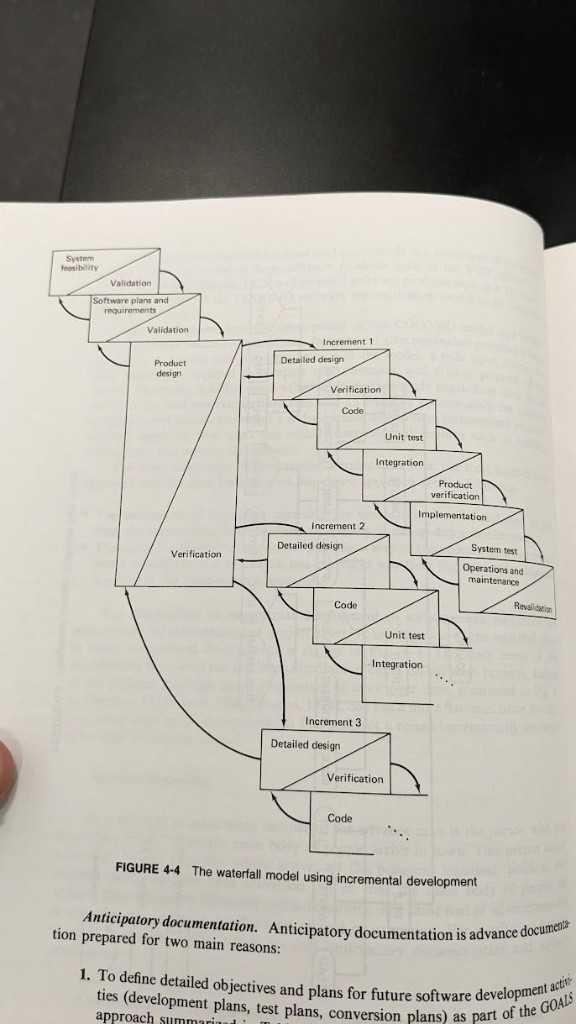
It is a structured way to picture delivery in slices without pretending that upstream decisions never change.
Subgoals, verification, and validation (Chapter 4)
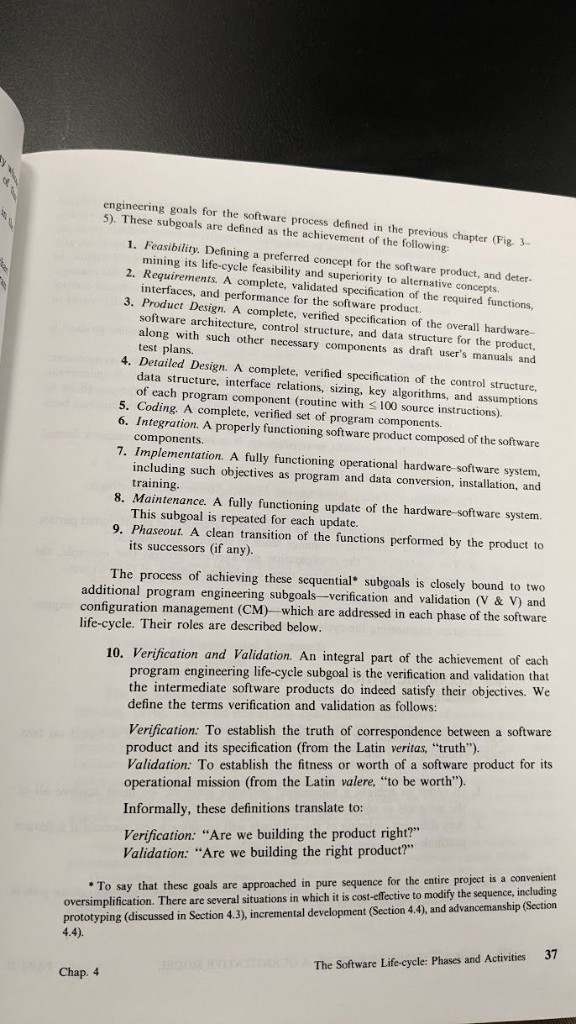
This page lists nine engineering subgoals in sequence: feasibility, requirements, product design, detailed design, coding, integration, implementation, maintenance (repeated per update), and phaseout. It then defines verification as correspondence to specification — “Are we building the product right?” — and validation as fitness for the mission — “Are we building the right product?” Configuration management appears alongside V&V as another cross-cutting obligation. A footnote admits the strict sequence is a teaching simplification; prototyping, incremental development, and overlapping work are called out as common adjustments.
These scans are for my own revision; figures and wording belong to the original book and publisher. For related notes on compilers and grammars from another text, see the companion post on compiler pipeline, language genealogy, and parse trees.